
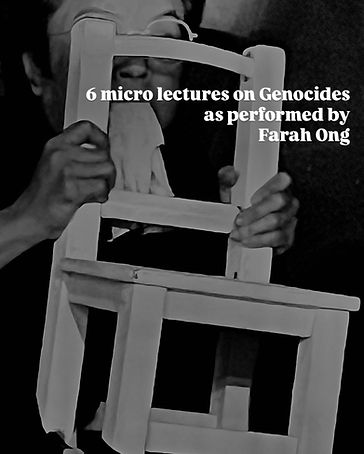
6 micro lectures on Genocides
22nd, 23rd, 24th, 25th January 2026 (performed by Rizman Putra)
27th, 28th February 2026 (performed by Farah Ong)
@ Drama Box Studio, Level 4
Rating: R18 (Mature)
Synopsis:
The performance was first thought of more than a year ago with this question: In this fragmented world, artists ask ourselves what do we do when we see atrocities, dispossession, mass killing and genocide.
When contemplating how to respond to the Genocide, Heng Leun and Rizman invited six writers - A Yagnya, Haresh Sharma, Nabilah Said, Neo Hai Bin, Oon Shu An, and Zulfadli Rashid - to write short lectures on Genocide, hence the title.
The performance premiered in Nepal at the International People’s Theatre Festival in March 2025. The performances in January with be the first time the show will be presented in Singapore.
6 Micro Lectures on Genocides
“So memorise this night of hurt by heart. You may well be the narrator, the narrative, and the narrated. Do not forget this narrow winding road that carries you, and that you carry, toward the boisterous unknown, that will cast doubts upon you and your people.”
Darwish, Mahmoud
IN THE PRESENCE OF ABSENCE
This poem reminds one that the most immediate act that an artist can do is to remember, as an act of resistance, such that narratives that are lies are countered and challenged.In this little island of Singapore, any conversation about Gaza is always conducted with so much caution. Warnings from the government that instead of calling out the injustice, we should focus on humanitarian efforts.This work focuses on this disquiet, deafening and alienating silence on Genocide in Singapore, and maybe even in many parts of the world still.
Order of Lectures:

Credit:
Devised by
Directed by
Performed by
Sound Design by
Music for Carcass composed and sung by
Multi-media Design by
Lighting Design by
Poster Design by
Writer
(in order of lecture)
Featuring the voices of
Special thanks
Rizman Putra
Kok Heng Leun
Kok Heng Leun
Rizman Putra (22nd, 23rd, 24th, 25th January 2026, 8pm)
Farah Ong (26th, 27th, 28th February 2026, 8pm)
Bani Haykal
Bani Haykal
Pupil
Emanorwatty
Han Xuemei
Oon Shu An, Neo Hai Bin, Tamer Nigim, Amna, Raghad, A Yagnya, Zulfadli Rashid, Haresh Sharma, Nabilah Said
Oon Shu Ann, A. Yagnya, Neo Hai Bin and Nabilah Said
Elle Cheng as Crew,
Wendy Chua, Xiang Bin &
Drama Box
FOH Support: Ang Rui Xuan, Catherine Lee Wai Yee, Chew Shaw En, Fervyn Kate Tan, Heng Jia Min, JOsephine Lee, Lilian Lau Shu Mei, Lim Jin Li, Lineng Tee, Yow Sheun Chin
For Feedback:
Dear Friends,
Thank you for coming to the show.
We welcome your reflections.
Share them on social media with #6microlectures #ongenocides
or to us at theriverproduction22@gmail.com
Good Night!
Yours sincerely,
theriverproduction
Biographies of artists:
Bani Haykal
bani haykal experiments with text + music.
As an artist and musician, his work revolves around human-machine relationships / intimacies, examining and reflecting on how tools and technologies have shaped and continue to shape our experiences from commuting to communicating, navigating places and people.
Manifestations of his research culminate into works of various forms including site-responsive installations, poetry and performance. In his capacity as a collaborator and a soloist, bani has participated in festivals including Other Futures (Netherlands), MeCA Festival (Japan), Wiener Festwochen (Vienna), Media/Art Kitchen (Indonesia, Malaysia, Philippines and Japan) and Liquid Architecture (Australia / Singapore) among others.
Farah Ong
Farah Ong is an independent artist—an actor, performance artist, voiceover artist, and teaching artist. Her recent stage credits include Geng Rebut Cabinet by Teater Ekamatra and The Death of Singapore Theatre as Scripted by The Infocomm Media Development Authority of Singapore by Wild Rice.
Haresh Sharma
Haresh Sharma has been the Resident Playwright of The Necessary Stage since 1990. He has written more than 130 plays which have been staged in over 20 cities. His play, Off Centre, was the first Singapore play selected by the Ministry of Education as a Literature text for GCE N- and O-Levels. In 2017, Haresh had the honour of having a selection of his plays featured at Esplanade’s first playwright-centred season at The Studios. In 2021, he published Reading the Room: A Playwright’s Devising Journey, which documents his journey as a playwright and theatre-maker in Singapore. He is the recipient of the Cultural Medallion Award and the Southeast Asian Writers (or S.E.A. Write) Award. In 2025 he was conferred an Honorary Doctor of Arts by Bath Spa University (UK).
Han Xuemei
Han Xuemei is a theatre director, facilitator, educator, designer and Co-Artistic Director of theatre company Drama Box. She believes that theatre can inspire growth, and creates works that engage audiences from all walks of life.
Kok Heng Leun
Kok Heng Leun is a prominent figure in the Singapore arts scene, having built his artistic career as a theatre director, playwright, dramaturg and educator. He is known for engaging the community on various issues through the arts, championing civic discourse across different segments of society.
Having begun his work in the theatre more than 30 years ago, some notable directorial works include Drift , Trick or Threat, Manifesto and Underclass. His explorations with multi-disciplinary engaged arts has produced works like site-specific theatre ubin, Project Mending Sky (2008, 2009 and 2012), a series on environmental issues, Both Sides, Now (2013, 2014 and 2017-2019), a project that seeks to normalise end-of-life conversations and It Won't Be Too Long, which touched on the dynamics of space in Singapore. Tanah•Air 水•土:A Play In Two Parts was about the dispossession of the indigenous Malays and Orang Seletar of Singapore.
Heng Leun's contributions to the arts have landed him awards from the National Arts Council, Singapore – the Young Artist Award (2000), Cultural Fellowship (2014), and the highest artistic accolade, the Cultural Medallion (2022). He also served as a Nominated Member of Parliament from 2016 to 2018, representing the arts sector.
In 2024, he received an honorary doctorate from the National University of Tainan, for his achievements in the fields of academia, arts and education.
Nabilah Said
Nabilah Said is a playwright, editor, and artist who works with text. She has presented plays in Singapore and London, including ANGKAT (Best Original Script, Life Theatre Awards 2020), and Inside Voices (Outstanding New Work, VAULT Festival, London). She has also created poetry installations for the Singapore Art Museum and Singapore Art Week 2023. nabilahsaid.com
Neo Hai Bin
Neo Hai Bin is a performance maker, educator, and writer. He began his theatre debut with Drama Box in 2009, and studied actor’s training practices with SCOT (Summer intensive 2014, Japan) and SITI Company (Summer Workshop 2019, NYC). Some of his physical theatre works are Being:息在 (M1 Fringe Festival 2022), Transit步 (Esplanade eXchAnge 2023), and OX (Kaleidoscope.V 2023). His literary practice includes scripts, prose and novels.
Oon Shu An
Oon Shu An is an actor and host who has been spreading her natural warmth and energy across theatre, TV, film and the internet.
Her works in theatre include Grounded, Lungs, Tartuffe and Chinglish. Her TV work includes Meet the MP and Code of Law for Channel 5 and Netflix's Marco Polo. In film, she has appeared in notable works like Rubbers, 4Love, and Smoke Gets in Your Eyes.
Her one-woman cross-media show, #UnicornMoment with Checkpoint Theatre, explored looking into our histories, the people in our lives, worth and identity. Her video My 5-Minute Magic Routine examined the notions of beauty and self love in our society, and another video Here I Am was an exploration of the idea of national identity viewed from different perspectives.
Pupil
Pupil is an organ of sensing and learning.
Rizman Putra
Rizman Putra has been actively juggling performance, visual arts, and music for the past twenty years after earning a Master of Arts (Fine Arts) from LASALLE College of the Arts in 2007. In 2005, Rizman was one of the four artists selected for the President’s Young Talents Exhibition and was part of the Fukuoka Triennale. In the same year, the now-dissolved arts collective he co-founded, Kill Your Television (KYTV), was awarded the Japanese Chamber of Commerce & Industry (JCCI) Singapore Foundation Arts Award. Rizman has performed locally and internationally and at the inaugural Singapore Biennale in 2006. Rizman is one-half of the retro-futurist electronic duo NADA and is currently an Associate Artist with Cake Theatrical Productions.
Tamer Nijim, Amna, Raghad, A Yagnya
Tamer is a Gazan theatre maker and teacher.
He is currently a refugee in Cairo.
Amna is a home maker, and mother of 3.
Raghad enjoys studying and dreams of being a doctor.
Amna and Raghad are currently displaced within Gaza and live in a tent.
Yagnya is a Singaporean playwright-director. @iggyeggieggyagnya
Zulfadli Rashid
Zulfadli Rashid is a playwright and transcreator fluent in English and Malay. His notable works include the award-nominated musical Alkesah and a Malay-language adaptation of A Clockwork Orange. His first play compilation, Kolong, showcases his versatility. Zulfadli is dedicated to cross-disciplinary collaborations, creating art that entertains, enlightens, and inspires across cultures and languages.

Reception at International People’s Theatre Festival, Nepal, Kathmandu
“Utilizing various rational states, including language, space, projection, devices, and the body, to explore a highly sensitive topic.
I watched this play in a rundown, poverty-stricken third-world theater in Kathmandu, feeling that the highly developed modernization brought another kind of invisible control, which has already been internalized in the nerves...”
Chung Chiao, Artistic Director,
Assignment Theatre,Taipei
“6 Micro Lectures on Genocides is a beautiful and painful journey that summons back into the present the questions that have long echoed in silence. This work speaks not through explanation but through experience, reaching us not through representation but through memory. It reveals how even the smallest gestures of daily life carry the shadow of violence, gently yet unmistakably shaking the audience awake. On stage, the performer lifts fragments left behind in the rubble of history and places them before us. The rules of a game board, the humble ingredients on a dining table, a letter written to a loved one— we cannot escape the wounds embedded in each of these. And yet, the piece refuses to remain in despair. It opens a narrow path—toward thinking again, feeling again, and reconnecting with what remains human in us. Ultimately, 6 Micro Lectures on Genocides shows how the very act of remembering can make us human once more. It is an unforgettable performance where profound sorrow and warm compassion flow side by side.
Jung Sang Bae, Artistic Director
The Space Theatre, Busan
“A people theatre worker constantly asks himself/herself what is the direction of the theatre work that he/she should pursue. At this juncture of time when the world has been going through havoc, I think many of us are especially concerned about wars and genocides and climate change.
And indeed, Kok of Singapore has got not one but 6 playwrights to create each a micro lecture on genocide and this is something to be greatly admired. The playwrights were addressing different genocides and not just those related to the Palestinians and Gaza… People’s theatres do theatres that remember – remembering so that we would not commit the same mistakes again. People’s theatres do theatre also for change.
One does not imagine that 6 micro lectures will stop genocide. How should the theatre actor make the presentation to the audience that can bring changes? If they present like a journalist speaking through a small box reaching people at home, it probably changes nothing. People just sit there and consume the images and the audio, and nothing happens. It will be just the same as the bomber's pilot who dropped that mega bomb and saw the targets hit from his camera without any emotion.
Our Singaporean actor Rizman Putra was doing it remarkably well, he held the stage; spoke with emotion; delivered the lines that struck the audience in the heart. Yes I think there needs to be a powerful emotional engagement with the audience first, then came the Brechtian alienation for them to think, and to change."
Gus Mok Chiu-yu,
Founder, Asia People’s Theatre Society